
Graded against the literature · per system, in the open
Simulate the molecule
before you synthesize it.
MoleculaPRO runs molecular dynamics to screen, design, and de-risk oil-recovery chemistry — cutting months of lab iteration down to hours of physics.

Mission & vision
Cutting-edge physics and chemistry for industrial use.
Mission
Use physics and chemistry to design and deliver the most advanced, customized chemical solutions for your business.
Vision
A world-leading platform ecosystem for getting end-to-end, customized chemistry for your use case.
Validation & rigor
Screen the chemistry before it reaches your lab bench.
Every simulation is grounded in peer-reviewed literature and checked against published reference systems — built for the R&D decisions that come before a physical trial, not after one.
Shortlist chemistries before synthesis
Screen candidate surfactant formulations by simulated interfacial and wettability behavior before committing lab time and reagents to physical synthesis.
De-risk an EOR chemical-pathway decision
Compare mechanism-level behavior — IFT reduction, wettability alteration — across candidate chemistries before deciding which pathway a field or core-flood trial should test.
Cross-check reservoir-fluid assumptions
Validate PVT and equation-of-state inputs against public field datasets before committing simulation budget to a full reservoir study.
Ground a trial proposal in molecular evidence
Support a core-flood or pilot proposal with mechanism-level simulation results, grounded in peer-reviewed literature rather than vendor claims.
Verified against peer-reviewed source literature to the highest standard we hold ourselves to; re-checked on a rolling basis. Across the properties benchmarked against a quantitative published reference — density, interfacial tension, viscosity, and self-diffusion — results have landed within single-digit percent, under 10%, of the reference value; other capabilities are benchmarked qualitatively or against a non-quantitative reference. Citations available on request.
Engineering rigor
- Every benchmark verdict — pass, indeterminate, or in-progress — is generated automatically, with no manual override path.
- Physics-boundary rejection is enforced as a release gate: temperature, pressure, box-size, and pH guardrails correctly reject out-of-bounds inputs before a simulation runs.
- Security and access-control checks, including path-traversal protection, are enforced as a release gate to the highest standard we hold ourselves to.
- Internal audits of the research corpus found no evidence of systemic fabrication — every discrepancy traced to a real, identifiable extraction error.
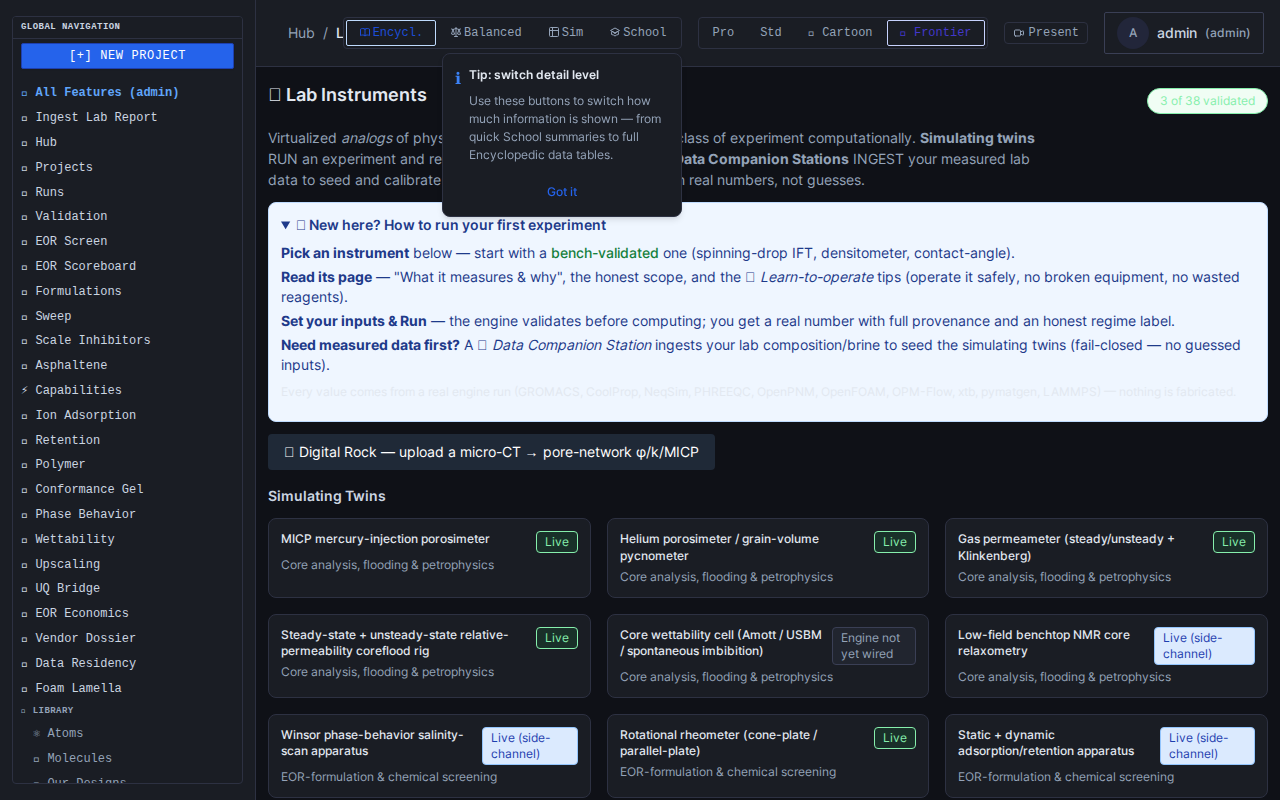
- Digital lab-instrument twins — interfacial tension, density, and contact angle — are bench-validated against literature-anchored reference values.
Data residency
Your formulations stay where you need them to.
Region-pinned data handling with an audited enforcement checklist — built for the procurement review before it's asked for, not scrambled together after.

Where this fits
Four stages of the EOR workflow — before the trial you'd rather not fail.
This is the real upstream and EOR workflow, start to finish. Our own engine and specialist network sit in the molecular-scale screening layer — the stages where a wrong assumption is still cheap to catch.
01
Exploration & Appraisal
Establishing whether a resource exists worth developing.
02
Field Development Planning & Reservoir Characterization
Core analysis, petrophysics, and static geological modeling that everything downstream depends on.
Formation and mineralogy assumptions get locked in before a full core-analysis program ever confirms them.
03
Primary & Secondary Recovery
Natural depletion, then waterflood or gas injection to maintain reservoir pressure.
04
EOR Screening & Candidate Selection
Ranking chemical, thermal, gas, or microbial recovery methods against your reservoir's properties.
Committing lab or field-test budget to a recovery pathway before knowing where the mechanism-level physics actually sits.
05
Lab & Bench-Scale Formulation Testing
Fluid-rock characterization and formulation screening, ahead of reservoir-condition coreflood testing.
Every candidate that reaches the bench, or the coreflood queue, costs reagents, core material, and calendar weeks before you know if it performs.
06
Simulation & Pilot Design
Field-scale reservoir simulation to design a pilot's pattern, injection scheme, and well spacing.
07
Pilot & Field Trial
A limited-pattern injection test, monitored and compared against simulation.
08
Full-Field Deployment
Implementing the validated process at full-field scale.
09
Production Monitoring & Scale Management
Ongoing surveillance, conformance work, and produced-fluid/scale management as the flood matures.
Scale precipitation from an incompatible injection water shows up downhole or at the facility — long after the water-source decision was already locked in.
Exploration, field-scale simulation, physical pilot execution, and full-field deployment stay with your team and existing service providers — that's deliberate, not a gap. Our job is the molecular-scale screening layer in between, so those later, more expensive stages start from a shortlist that's already been checked against the physics.
Capabilities
Full-stack computational chemistry, deployed the day you need it.
Every capability below runs on our engine today — production-grade, no build-out required. Example deliverables that combine several of them: a CO₂-EOR screening memo (MMP + PVT + relative-permeability benchmark) and a surfactant formulation-optimization memo (IFT + adsorption + PVT + scale).
01Interfacial & surfactant chemistry
- Interfacial tension (IFT)block averaging + autocorrelation-based error analysis
- Critical micelle concentrationML prediction (fast screen) + metadynamics (physics-based confirmation)
- Adsorption free energyumbrella sampling
- Surfactant aggregation numbertrajectory clustering
02Reservoir & flow properties
- ViscosityMD (Green-Kubo)
- Self-diffusion & ion behaviorat mineral surfaces
- Miscible-gas EOR screeningMMP, first-contact miscibility
- Computed relative-permeability curvespore-scale flow simulation, Darcy-flow benchmark
03Petrophysics & formation
- Contact angle & wettabilityspherical-cap fit, mineral-surface parameterized (quartz, kaolinite, clay)
- Digital rock characterizationsegmentation & pore-network analysis of micro-CT volumes — porosity, pore-scale structure
- SEM-EDS data analysisautomated modal-mineralogy phase segmentation
- XRD / FTIR spectrum interpretationmineralogical & compositional analysis
04Fluid & facilities engineering
- PVT / equation-of-state modeling
- Scale saturation indicesbrine compatibility
- Permeability & porosity (pore-network simulation)benchmarked against gas-permeameter / porosimetry reference data
This list is what our own engine computes directly. For the fuller petroleum-engineering and chemistry agenda — delivered through our specialist partner network — see below.
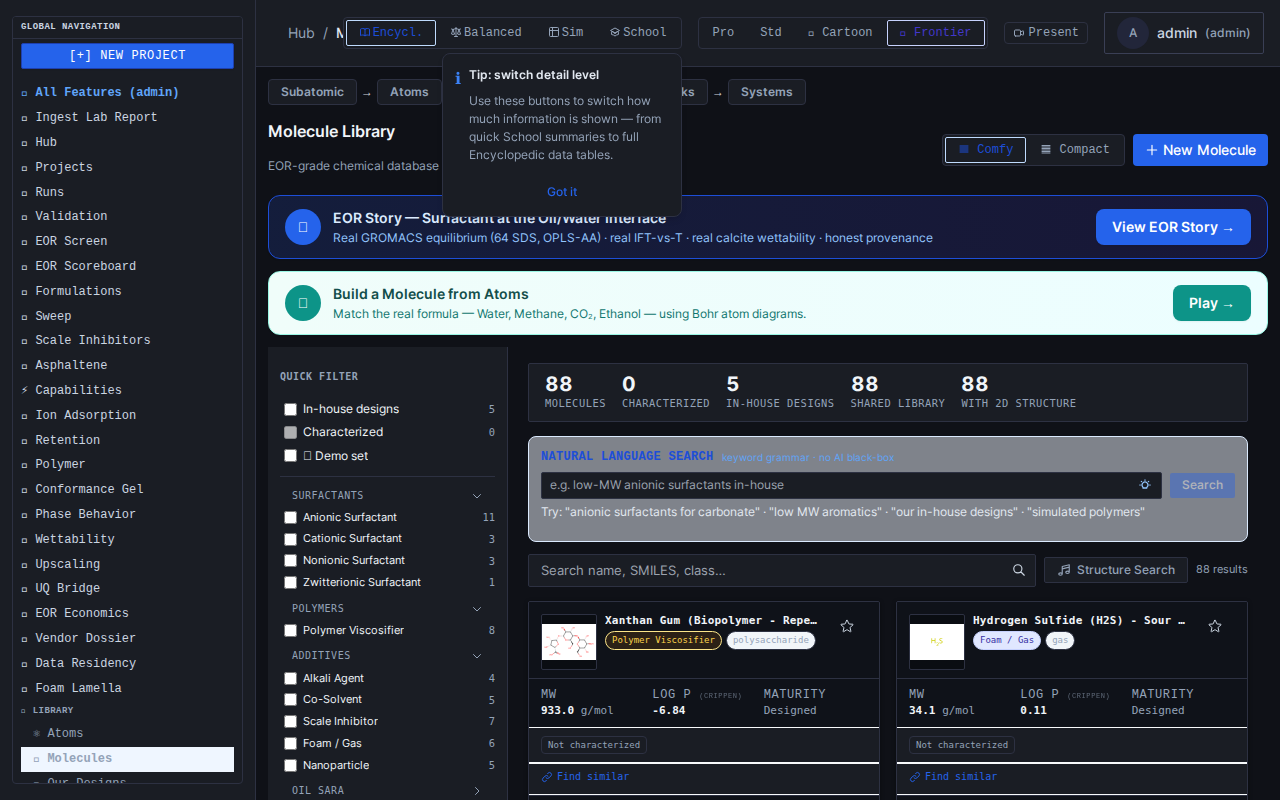
Inside the platform
Not a mockup — this is what running it looks like.
Unedited screenshots from the working application.
Business challenges
Where this actually gets used.
01
Surfactant selection for chemical EOR →
Spend synthesis budget on candidates that clear a screen first.
02
Wettability alteration screening →
Protect core material and lab time from a mineral-surface mismatch.
03
Miscible-gas / CO2-EOR screening →
Prioritize which injection scenarios earn a slim-tube test.
04
Reservoir fluid & scale compatibility →
Catch a scale-forming water mismatch before it's a wellbore problem.
05
Reservoir rock & mineralogy characterization →
Cross-check formation assumptions before a core-analysis program is committed.
06
Injection-scheme & coreflood pre-screening →
Protect scarce core material for schemes that clear a screen first.
07
Screening a vendor-proposed formulation →
An independent data point before you commit to someone else's chemistry.
Full agenda
End-to-end chemistry — scoped to exactly what you need.
A meaningful share of what a full petroleum-engineering and EOR-chemistry program needs already runs on our own engine, today — see Capabilities, above. Beyond that, every engagement is scoped personally by our founding team — researchers with direct field-development and core/fluid-analysis experience — who bring in the specialist network a given project actually needs. The full agenda below is delivered that way, project by project.
01
Native engine
Runs on our platform today — see Capabilities, above.
02
Named agenda
The list above. Delivered through our specialist network, project by project.
03
Everything else in the field
Petroleum engineering or EOR chemistry, not listed above? Ask on the intro call — we'll give you a direct answer on whether we can staff it.
Where the chemistry is proven
Enhanced-oil-recovery chemistry, at reservoir conditions.
MoleculaPRO's core simulation work is active in petroleum-engineering formulation — colloid chemistry, core and fluid analysis, and chemical-EOR surfactant design. Client and site details stay confidential; the chemistry doesn't need a name attached to be real.
Formulation
Chemical-EOR surfactant design — the same SDS-class chemistry rendered in the hero above.
Reservoir-condition modeling
Field-condition-specific modeling — salinity, temperature, and core/fluid interaction analysis.
Colloid chemistry
Interfacial-tension physics at the molecular scale — the founding team's own research specialty.
Who this serves
Built for the teams closest to the reservoir.
Different reservoirs, different reagents, different constraints — the same engine underneath.
01
Upstream E&P operators
Screen surfactant EOR formulations against reservoir conditions before committing to a field pilot.
02
Petrochemical & specialty-chemical manufacturers
Evaluate alternative formulations and suppliers computationally before physical synthesis.
03
Oilfield service & completion-fluid companies
Additive and completion-fluid chemistry, from screening through scale-inhibitor design.
04
Research institutes & universities
Reproducible, literature-benchmarked MD methodology for publication-grade work.
For academic researchers →05
Engineering & technical consultancies
Petroleum-engineering depth beyond in-house bandwidth — scoped personally by the researchers behind the platform, staffed through our specialist network.
Research library
The literature foundation behind every simulation.
Every observable in the platform traces back to a real, independently-sourced publication — not an internal assumption.
Proprietary
Research database, continuously growing
Extensive
Catalogued observable set
Expanding
Simulation engines in active integration
Ongoing
Database verification cadence
FAQ
Questions we'd expect you to ask.
Is this generative AI, or physics-based simulation?
Molecular dynamics is physics-based, not data-fitted at the property level: it integrates Newtonian motion on a force field parameterized from quantum-chemical and experimental reference data, not a statistical model fit to historical property values. That's a different tradeoff than ML property-prediction tools, which are fast but only as reliable as their training distribution — though a classical force field still needs correct atom typing and parameters for genuinely novel chemistry, which is its own limit on how far it extrapolates.
How do you validate accuracy?
Every simulation is checked against peer-reviewed literature and public reference systems, not just internal review — see Validation above and the engineering-rigor detail below it.
What happens to our formulation data when we submit a simulation job?
Customer formulations and simulation inputs are treated as confidential; specifics (data residency, on-prem vs. managed deployment, NDA terms) are scoped on the intro call — see Pricing.
What's live today vs. on the roadmap?
Capabilities lists what our own engine computes natively, today. The full petroleum-engineering and chemistry agenda beyond that is delivered through our specialist partner network — we keep that distinction explicit rather than blurring it into one list.
What if what we need isn't on the Capabilities or agenda lists?
Ask us on the intro call. Our founding team is made up of active petroleum-engineering researchers with a working network across the field — we'll tell you directly whether we can scope and staff it, rather than leave the question open.
How does pricing work?
No public tiers — we scope pricing on a short call against your actual screening throughput and deployment requirements. See Pricing.
Pricing
Scoped to your simulation workload.
Every deployment differs. We scope pricing on a short call rather than force-fit a generic tier.
Contact temporarily paused — finalizing data-handling registration.
What we scope on the call
- Screening throughput & deployment scale
- Which engines you need integrated
- On-prem vs. managed deployment
- Data residency & compliance requirements

Get started
Bring us your chemistry problem. We'll show you what physics says before you commit a lab to it.
Screen the formulation computationally first — scoped to your workload, on a short call. Every cycle spent finding out the hard way is lab time and calendar weeks you don't get back.
Contact temporarily paused — finalizing data-handling registration.
Proprietary
sourced publication database
<10%
deviation from published reference values, on quantitative benchmarks
Growing
native engine capability set
Bench-validated
digital lab instrument library